

The Invisible Hand: how do brushes affect the stone’s path in olympic curling?
The Foundation: The Pebbled Ice and the Physics of Curl
Before understanding how sweeping works, one must first understand the unique surface the game is played on. The ice used in curling is not the smooth, hard surface of a hockey rink. Instead, before a match, a technician sprays a fine mist of water droplets over the ice, creating a “pebbled” surface. These tiny bumps of ice, which feel like coarse sandpaper, are the foundation of the sport itself .
The pebbled ice serves a dual purpose. First, it reduces the overall friction between the heavy stone and the ice, allowing it to glide more easily. Second, and more importantly, it is the primary cause of the stone’s famous “curl.” As the stone travels, it rotates, and its leading edge interacts with these ice pebbles. The friction on the front of the stone is slightly higher than on the back, and the stone’s rotation creates an asymmetrical contact pattern that causes it to “turn” in the direction of its rotation .
This complex interaction is the subject of ongoing scientific inquiry. While the exact mechanism is still debated, a recent model described in the journal International Journal of Refrigeration proposes that it comes down to microscopic interactions. The model suggests that “asperities” (tiny bumps or irregularities) on the stone’s running band collide with the ice pebbles. Friction from the stone’s leading edge melts a thin layer of water on the pebble’s top. The resulting “pivot-slide effect” alters the stone’s trajectory, effectively pushing it to one side or the other . The stone curls because of these minuscule, uneven forces. It is this natural curl—which is never perfectly straight—that the sweepers are trying to manage.
The Primary Effect: How Sweeping Extends the Run
The most fundamental reason for sweeping is to extend the distance the stone travels. A stone that is not swept will eventually come to a halt due to the friction of the ice. Sweeping changes this equation. When a sweeper vigorously brushes the ice in front of the stone, the friction generated by the brush head heats the surface . This friction melts the sharp tips of the ice pebbles, creating a thin, transient layer of water on the ice. This thin film acts as a lubricant, significantly reducing the coefficient of friction between the stone and the ice .
The result is a stone that glides further with less deceleration. This is a critical element of strategy. If a stone is thrown with insufficient weight, sweepers can “drag” it an extra few meters to reach the target area, known as the “house” . Conversely, if a stone is thrown too heavy, they won’t sweep, allowing the friction to slow it down more quickly. This allows curlers to “control the stone’s speed, trajectory and curl” according to the Olympics official site . In essence, sweeping provides an active, in-game adjustment to the stone’s energy and potential.
The “Does it Speed Up?” Debate
A common misconception is that sweeping makes the stone go faster. In reality, the sweepers are not adding kinetic energy to the stone. The force they exert on the ice doesn’t push the stone. Instead, they are preserving the stone’s existing kinetic energy. By reducing friction, they allow the stone to travel further for a given initial velocity. As the Metro report explains, “sweeping… will help make the rock go faster, curl less and create a smoother path for the stone to travel down” , though it’s more accurate to say it appears to go faster and travels further because it loses energy more slowly. It is a subtle but important distinction for understanding the physics at play.
The Second Order: Directional Sweeping and Curl Control
While extending distance is critical, the true artistry of sweeping lies in its ability to control the stone’s curl. This is where the simple concept of “heating the ice” expands into a complex and, until recently, scientifically debated realm of directional sweeping. While it is widely performed, the scientific evidence for its effect on curl has been less clear, with researchers noting that “there is little scientific evidence to support the curl-controlling effects” .
However, a groundbreaking study published in Sports Engineering in 2024 has begun to quantify these effects, confirming what top curlers have long claimed: sweeping can indeed be used to change the stone’s lateral movement . The study found that “half-side sweeping,” where only one side of the stone’s path is swept, has a “nonzero curl-controlling effect with a statistical significance” . Specifically, the research found that sweeping on the right side of the path resulted in a measurable shift, supporting what is known as the “repulsive” effect .
Techniques of a Master Sweeper: Pressing, Knifing, and Asymmetry
This scientific validation has empowered elite teams to further refine their techniques, turning sweeping into a specialized skill alongside throwing. According to the World Curling Federation, top sweepers now employ distinct methods, each with a specific purpose:
The Pressing Technique: This is the modern standard for extending the stone’s run and, crucially, holding it straight. By pressing down with their entire body weight on the brush without moving the head in front of the stone, sweepers can dramatically increase the downward force. This creates more friction on the ice, generating a more substantial layer of meltwater and allowing the stone to travel further and straighter . This technique is a significant departure from the traditional “scrubbing” motion and is a testament to the sport’s evolving understanding of physics.
The Knifing Technique: This is a more controversial and less common method. Sweepers use the thin edge of the brush head to sweep at an angle, reportedly attempting to drag the stone sideways to encourage more curl. However, even among elite curlers, the effectiveness of this technique is debated, with some stating they have not tested it enough to confirm its effects .
Directional Sweeping and the “Inside” Sweep: The most common way to influence curl is through asymmetrical sweeping. This involves sweeping on only one side of the stone’s path. The modern theory, which the 2024 study supports, posits that sweeping one side of the stone creates a “repulsive” effect, effectively “pushing” the stone toward the opposite side . For example, if a curler wants to make the stone curl less (straighten it out), they will sweep the “inside” (or slow side) of the path. If they want the stone to curl more, they will sweep the “outside” (fast side) to create a greater curl toward the inside .
The Ice is the Enemy: Cleaning and the “Worst Ice”
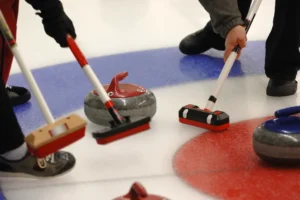
Beyond the physics of friction and curl, sweeping serves a more practical purpose: cleaning the ice. Over the course of a game, small bits of debris—stray hairs, dust, or ice chips from the stones themselves—can accumulate on the playing surface. Even a tiny piece of debris can act as a foreign object, catching the edge of a 44-pound stone and knocking it off its intended trajectory . This concept is so well-known in the sport that it has been described as the “worst ice,” a condition where debris is so common that stones are frequently deviated from their path.
Vigorous sweeping in front of the stone essentially acts as a final cleaning pass, clearing the path of any potential obstacles. This ensures that the stone’s path is determined solely by the physics of the ice and the throw, not by the capricious nature of a rogue dust particle.
The Arms Race: Technology, Regulations, and the Future of Sweeping
The immense influence of the brush has led to a technological arms race over the years, which has forced the World Curling Federation (WCF) to step in. Historically, brushes were made of corn straw. The transition to synthetic fabrics and carbon fiber handles created lighter, more efficient tools . However, manufacturers began creating brush heads with aggressive, rough fabrics designed to “scratch” the ice. These scratches could create grooves that could be used to “steer” the stone, much like a groove on a bowling lane.
This reached a boiling point in 2016 when high-level curlers demonstrated just how dramatically these new brushes could manipulate the stone’s path. The concern was that it would “ruin the sport” by making the game too dependent on the brush and diminishing the skill of the throw . In response, the WCF banned the use of ice-scratching fabrics in 2016, and in 2025, they updated the standards again, mandating a specific material (a 0420 Denier 100% Nylon) to limit the ability to alter the ice surface mechanically .
However, this hasn’t stopped the evolution of the sport. As Craig Savill, a two-time world champion, noted, “Teams can manoeuvre the rock even now if they know the right angle of sweeping” . Teams are now focusing on technique over technology. As one Olympic champion, Sweden’s Rasmus Wranaa, explained, teams are constantly testing new sweeping angles, pressure points, and the best ways to “manage the stone along the sheet,” observing others and adapting their styles for different ice conditions .
The sport has also seen a shift in strategy, with a growing trend of using only one sweeper, the one deemed most effective, to control the direction of the stone. “The sweeper who is further from the stone has a much lower impact,” Wranaa notes, so it is not only more efficient but often more effective to let the best sweeper work .
Conclusion: A Symphony of Physics and Human Touch
The brush in Olympic curling is far more than a simple broom. It is a sophisticated tool that allows athletes to manipulate the fundamental forces of physics in real-time. By generating heat through friction, sweepers reduce the stone’s friction with the ice, extending its journey and clearing its path. By applying specific pressures and targeting particular sides of the stone’s trajectory, they can actively influence its curl, guiding a 44-pound stone to within millimeters of a target 150 feet away.
From the groundbreaking scientific models of asperities and pivot-slides to the practical, sweat-soaked experience of the athletes themselves, the sport of curling is a testament to the invisible forces that govern our world. It is a game where understanding the microscopic interaction between a piece of granite and a frozen water droplet is just as important as physical strength. As the scientific and athletic communities continue to study the sport, with institutions like the University of Saskatchewan conducting ongoing research into the effects of sweeping, the brush’s role will only become more precisely understood .
This knowledge will continue to shape the strategies of Olympic curlers, turning a seemingly simple act of sweeping into a complex, calculated battle against friction, the ice, and the relentless pursuit of perfection. The brush is the athlete’s primary tool in this battle, and in the silent arena of the curling rink, it is the loudest voice.