

Tindyebwa Agaba Wise: A Journey from Child Soldier to Advocate and Healer
Introduction: The Unfathomable and Inspiring Odyssey
Tindyebwa Agaba Wise’s life story is one of the most compelling narratives of our time—a testament to the indomitable human spirit’s capacity to endure unimaginable darkness and consciously choose to become a beacon of light for others. His journey defies simple labels: he is a survivor of the Rwandan Genocide, a former child soldier, a refugee, a scholar, a human rights activist, a charity founder, a detective, a husband, a father, and the adoptive son of acclaimed actress Emma Thompson and actor Greg Wise.
This is more than a biography; it is a profound exploration of how radical empathy, unwavering resilience, and the redefinition of family can forge meaning from tragedy and purpose from pain. The odyssey of Tindy Agaba, as he is affectionately known, challenges us to reconsider our perceptions of refugees, trauma, and what it truly means to rebuild a life.
The Shattered World: Childhood Amidst Genocide
Tindyebwa Agaba was born in Rwanda in the late 1980s into a humble family. His early years, though marked by poverty, were grounded in the simple rhythms of rural life, Catholic faith, and the love of his parents, who were determined to provide a better future for him and his three sisters. This fragile stability was irrevocably shattered when he was nine years old with the death of his father from AIDS—an event that brought both profound grief and crippling social stigma upon the family, forcing the children out of school.
Worse was to come. As ethnic tensions in Rwanda escalated toward the horrific genocide of 1994, militia men stormed his village. In a scene of unspeakable violence, Agaba, then around twelve years old, was forcibly separated from his mother and sisters and abducted alongside other children. Marched for days into the bush, the boys and girls were divided into different groups.
That moment was the last time he ever saw his sisters, their fate forever unknown to him. He was taken to a militia base camp, where he was to spend the next three years being trained as a child soldier, subjected to and witnessing brutalities no child should ever endure. This period, which should have been filled with education and play, was instead defined by fear, violence, and the systematic destruction of innocence.
Escape and the Long Road to Refuge
Agaba’s escape from this nightmare is a testament to his tenacity, though details remain sparse in his telling, perhaps out of respect for others’ safety or the difficulty of the memory. He eventually found himself in a refugee camp in Uganda, a place offering scant safety and little hope, characterized by overcrowding, food scarcity, and a pervasive sense of limbo.
A pivotal turn came through the intervention of a worker from the humanitarian organization Care International. Recognizing his desperate situation, they helped facilitate his journey to the United Kingdom in 2003 to seek asylum. He arrived in London at age 16 as an unaccompanied minor, speaking little English, carrying no documents, and bearing the deep psychological wounds of his past. His early days in Britain were a new kind of struggle.
A bureaucratic glitch with the Home Office left his support allowances severed, rendering him homeless. He slept on the streets around Trafalgar Square and in hostels, a scared and lonely teenager in a bewildering, cold, and unfamiliar city where “every white person looked the same”.
The Fateful Meeting: A Family Forged by Choice
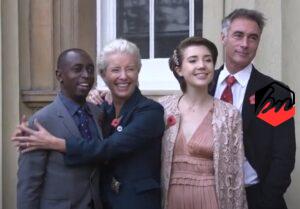
In December 2003, Agaba attended a Christmas party organized by the Refugee Council, a UK charity supporting refugees. The event was hosted by its patron, actress and activist Emma Thompson. Suspicious of adults after his traumatic past, Agaba was initially wary when Thompson, moved by his spirit, struck up a conversation. Their communication was a “combination of sign language, laughing, [and] smiling”. Grateful for a hot meal, he thanked her, and a connection was forged.
Two weeks later, Thompson tracked him down and invited him to spend Christmas Eve at her home with her husband, Greg Wise, and their young daughter, Gaia. Paranoia battled with a deep yearning for connection. “What does she want?” he asked himself, his life experience suggesting that encounters with unfamiliar adults “usually ended very badly”. Nevertheless, he went. The warmth, normalcy, and consistent kindness he encountered there began to thaw his defenses. Invitations became weekends, and weekends turned into a sustained presence in the family’s life.
Within a year, the bond had deepened organically. “I just started calling her Mum,” Agaba recalls. Thompson’s response was simple and profound: “Why don’t we just try it”. Though the legal adoption process was complex, they considered him their son from that day forward, creating a powerful, chosen family built on mutual respect and love. In a poignant reflection, Emma Thompson later stated, “Sometimes being friends is not enough. You need family”. She has also expressed gratitude that her attempts to have a second biological child were unsuccessful, saying, “every day I’m grateful for Tindy”.
Key Phases in Tindyebwa Agaba Wise’s Life Journey
| Life Phase | Key Experiences | Primary Location | Defining Challenge |
|---|---|---|---|
| Early Childhood | Family life, father’s death from AIDS, ostracization | Rwanda | Loss of stability and education |
| Adolescence | Abduction, forced service as a child soldier | Rwanda/DRC Border | Survival amidst genocide and violence |
| Refugee | Escape, life in camps, journey to the UK | Uganda / United Kingdom | Homelessness, uncertainty, cultural shock |
| Integration & Education | Meeting the Thompson-Wise family, formal education | United Kingdom | Learning language, healing trauma, academic pursuit |
| Advocacy & Career | Human rights work, founding Muryango, detective work | United Kingdom / Global | Translating personal experience into systemic help |
Education: Rebuilding the Mind and Finding a Voice
With the stability and emotional support of his new family, Agaba focused intensely on his education, the path he saw to reclaiming his agency. He learned English, aided by speech lessons funded by Thompson and taught by renowned dialect coach Joan Washington. He excelled academically, earning a place at the University of Exeter.
In July 2009, he graduated with a 2:1 honors degree in Politics and International Relations, a moment of immense pride captured in university archives with his beaming adoptive parents by his side. He famously described his university journey as going “from hell to heaven in three years”. He then pursued a Master’s degree in Human Rights Law at the prestigious School of Oriental and African Studies (SOAS) in London, solidifying his academic commitment to the forces that had shaped his life.
The Search for Purpose: From “Cog in the Machine” to Grounded Activism
Armed with his degrees, Agaba embarked on a career in human rights, but his initial experiences were disillusioning. In a powerful 2012 essay titled “A cog outside the machine,” he described working as an unpaid legal adviser for refugees with the UNHCR in Cairo. Witnessing the Arab Spring was electrifying, but the bureaucratic inertia and systemic inadequacies of the large organization left him feeling like an impotent “cog in a huge machine,” unable to see tangible results from his work.
This frustration led to an epiphany. A trip to Liberia with ActionAid, where he met former child soldiers brimming with untapped talent but starved of opportunity, revitalized him. He realized his unique perspective—as a survivor with a top-tier education—was not best used within rigid institutions but as an innovator and direct investor in people. He began planning social entrepreneurship projects aimed at reintegrating former combatants into their communities, focusing on skill-building and ownership. This philosophy of direct, personal impact would later define his own charitable work.
Founding Muryango and Advocacy in the UK
Driven by the desire to offer the kind of practical, holistic support he had needed upon arrival in Britain, Agaba founded the charity Muryango. The name, meaning “family” in Kinyarwanda, perfectly encapsulates its mission. Unlike large, impersonal systems, Muryango focuses on providing wraparound support to refugees and asylum seekers in the UK, particularly those from African backgrounds.
The charity’s work is intentionally comprehensive:
-
Practical Integration: Assistance with job searches, CV writing, and skills training.
-
Emotional & Social Support: Mentoring and community-building activities to combat isolation.
-
Navigating Systems: Helping beneficiaries access legal advice, healthcare, and education.
Through Muryango, Agaba ensures that support addresses both survival and the deeper human need for dignity, belonging, and the chance to thrive.
A Private Life and Public Voice
Agaba has fiercely protected his private family life. He is married; early reports referenced a wife named Jessica, while later, more credible profiles indicate he married He Zhang. He is a devoted father to his children, whom he shields from public view to give them a normal upbringing. This choice underscores his commitment to creating the stable, loving family environment he lost as a child.
Professionally, his path took another unexpected turn. For a decade, he served as a detective in London’s Criminal Investigation Department (CID), a role Emma Thompson described as “fascinating” and “very challenging”. This career demonstrated his continued desire to engage with complex societal issues and pursue justice from within the system.
His public voice remains dedicated to humanizing the refugee experience. Emma Thompson has spoken of how he opened her eyes to the “everyday racism” and subtle hardships refugees face long after they arrive. Agaba uses his story to challenge dehumanizing political rhetoric, hoping to replace fear with understanding. “I always tell people,” he says, “just because someone’s a refugee, doesn’t mean they don’t have values; that they didn’t have a happy childhood”.
Conclusion: The Alchemy of Trauma into Hope
Tindyebwa Agaba Wise’s story is not a linear “rags-to-riches” tale. It is a complex, ongoing process of integration and transformation—integrating shattered fragments of a past self with a newly built present, and transforming personal trauma into a public good. He represents what Emma Thompson calls the “peculiarly gifted” potential of refugees: individuals whose profound resilience and unique perspective on the world make them invaluable contributors to society.
His life stands as a powerful rebuke to indifference and a clarion call for compassion. It proves that family is defined by love, not DNA; that purpose can be forged from pain; and that no one is solely a victim of their history. From the killing fields of Rwanda to the halls of British academia, from the desolation of refugee camps to the warmth of a chosen home, Tindyebwa Agaba Wise has navigated an almost unimaginable journey.
In doing so, he has become more than a survivor; he is a healer, a builder, and a living testament to the idea that even the deepest wounds can, with support and courage, become wellsprings of strength and sanctuaries for others. His legacy is the enduring proof that humanity’s best responses to its worst atrocities are found in the simple, revolutionary acts of welcome, empathy, and the unwavering belief in every person’s right to rebuild their life.